
Bagaço (grappa)
So, with the grape juice bottled and the wine fermenting you might think that's it with the grapes. Think again, though... There's more goodness to get out of that fruit yet!
After draining the juice/wine from our large wine-making tub, we're left with a mass skins, seeds and stalks. And although it may look as if there's hardly any liquid at all in this 'waste', there's more than you might imagine – and the sugars in it are rapidly turning into alcohol. It can be passed through a still (or alambique) to make what in Italy is called 'grappa'; here the commonplace term is 'bagaço', which actually refers to the mash of skins and seeds. (Properly, the result is 'aguadente bagaçeira'; where 'aguadente' means spirits.)
So I shovel the smelly mass out into bags. If sealed to keep flies and bacteria out, it can be kept for some time before distilling. In this case, though, I've arranged to combine it with the bagaço of some friends and take it to a commercial distilling operation – which is a sideline of the local olive oil press! So last Thursday, off we went with about 180kg of this stuff in the car...
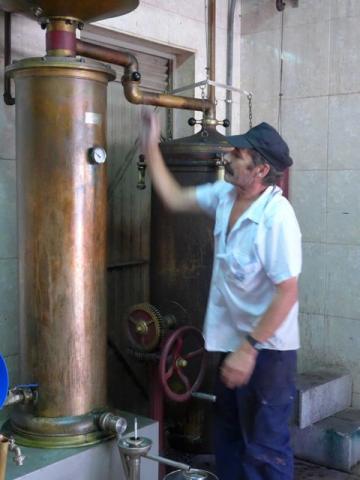
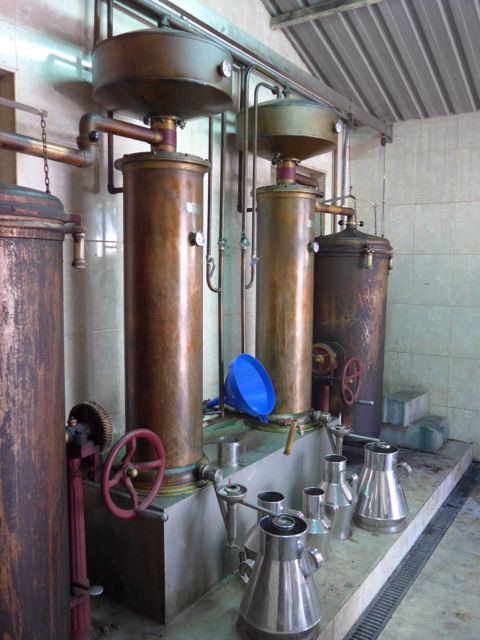
They run two of these 'columns' in parallel, each one taking up to 200 litres of mash. We booked one column.
We were expecting bit of a wait – and we got it! Not as bad as olive oil pressing time, but a 10am appointment saw us start the distillation closer to 1pm. Still the process is quite quick, and within the hour there was a large, well-used black plastic bucket full of our bagaço. Almost 25 litres of 63 vol% alcohol!
The process uses steam – it's piped in to the bottom of the column and as the mash gradually warms up the alcohol evaporates off first. It condenses down through the narrower of the two copper columns, from where it runs out into a collecting vessel.
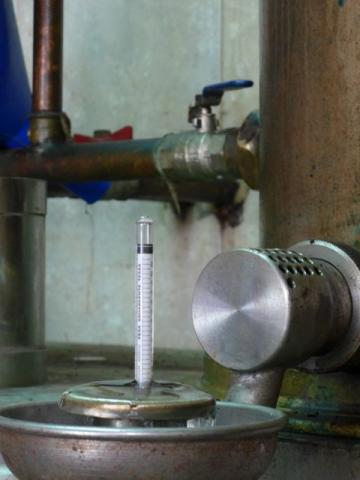
A hydrometer sits in the alcohol as it exits the condenser.
The operator keeps a careful eye on the alcohol reading as given by a special hydrometer. Toward the end, as the alcohol content of the runoff goes down, he carefully compares it with the bagaço in the large bucket – mixing in a little more, then a little more, until the final reading is about 63 vol% (actually, 23° on the ancient Cartier scale that they still use here). That's the strength that the Portuguese seem to prefer!
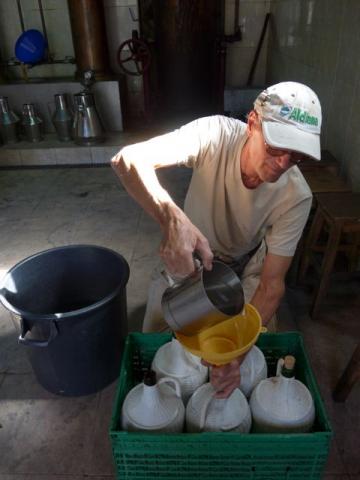
That's Dave filling our 5-litre demijohns – heady work!
So with that, we've got plenty of alcohol to keep us going! Some of this will go to tinctures and other similar uses. We'll make liqueurs. I've already added some to partially fermented grape juice to make a kind of port. But in reality there's no way we can use all of this... So it's a giveaway item, good for swapping, good for trading in our local currency system.
And then, of course, I still have all the skins from the second batch of wine that I made this year. The distilliery is busier now – so we have a column booked for 3am next Wednesday morning! (Like olive oil, bagaço is a serious business here and the plant runs 24 hours a day while there's demand!)
The only alternative is to do small quantities at a time in my own small alambique:
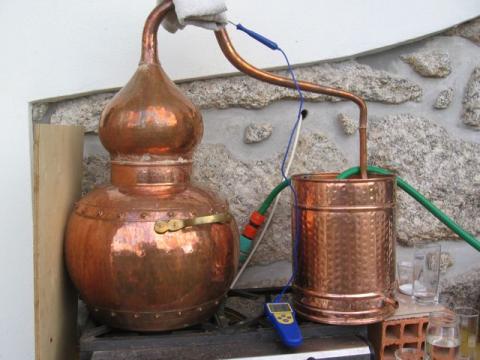
My 30-litre copper alambique (still).
I do use it quite regularly, but for these large quantities it is a lot of work and very slow. Later in the year, though, I'll probably give some of my bagaço a second distillation in it to bring the alcohol content up a bit. After a second run through, it usually reaches about 75 vol%, which is more suitable for tinctures.
- Log in to post comments